
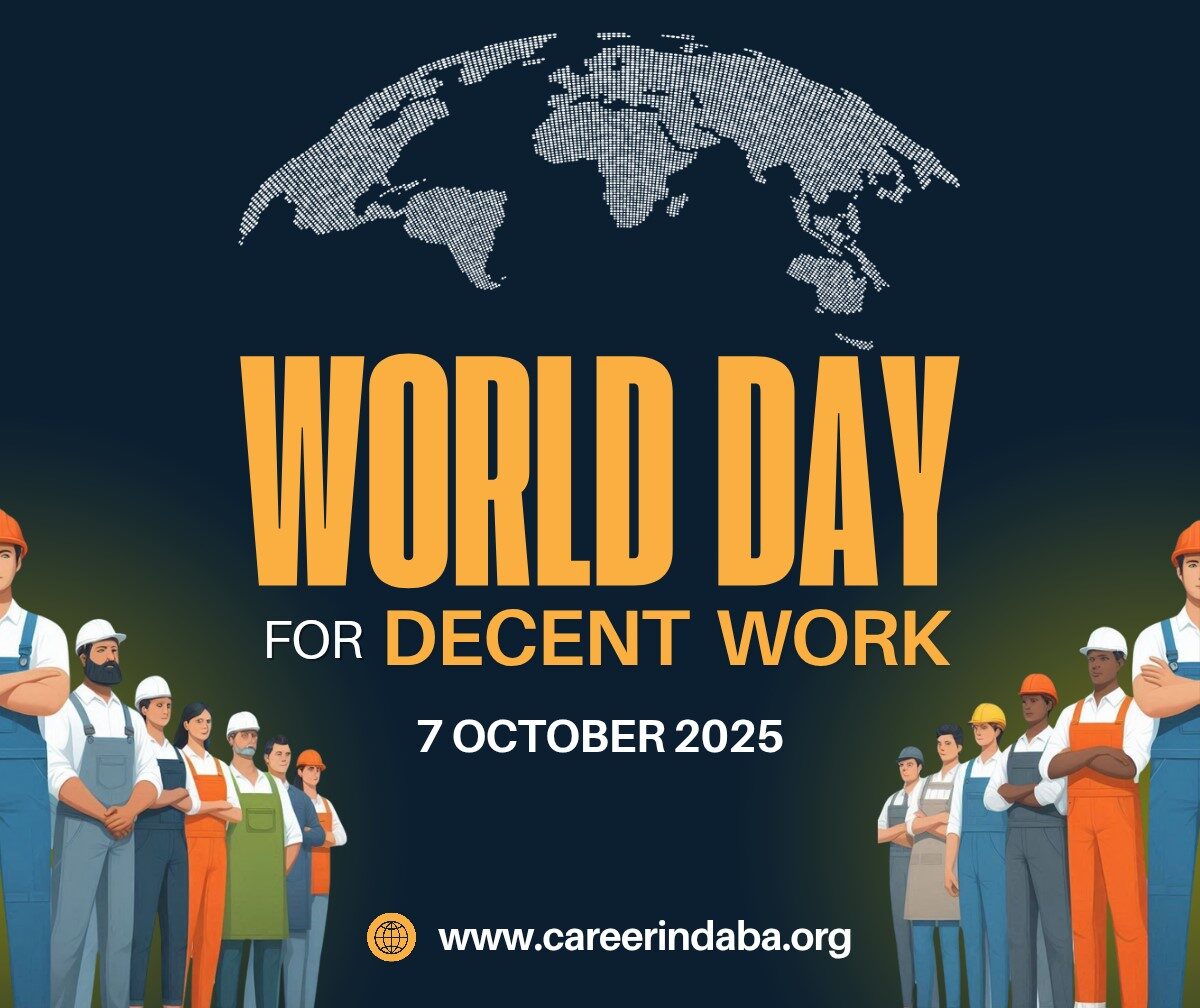
Every year on 7 October, the world pauses to observe the World Day for Decent Work, a global call to action championing dignity, fairness, and opportunity for every worker. It is a day that reminds us that economic growth without human dignity is hollow and that the promise of the United Nations’ Sustainable Development Goals, particularly SDG 8 on Decent Work and Economic Growth, remains unfinished business. This year’s observance takes place amid rising global inequalities, economic uncertainty, and the accelerating technological and green transitions that are redefining the world of work. It also presents an opportunity to reimagine the future of employment in Africa and to renew the global commitment to make decent work for all a lived reality by 2030.
The concept of decent work, first defined by the International Labour Organization, goes beyond employment numbers. It represents the right to productive, secure, and dignified work where workers earn fair income, operate in safe environments, and are treated with respect. Decent work is rooted in employment creation, social protection, rights at work, and social dialogue. “Decent work is not a luxury, it’s a basic human right,” said ILO Director-General Gilbert Houngbo in a 2024 global address. “Without it, we cannot achieve sustainable development or social justice.”
When world leaders adopted the 2030 Agenda for Sustainable Development, they placed decent work at the centre of global progress. SDG 8 calls on all nations to promote sustained, inclusive, and sustainable economic growth, full and productive employment, and decent work for all. But decent work is not confined to SDG 8 alone; it is the thread that connects nearly every goal in the 2030 Agenda. Work is the route out of poverty and inequality. Safe and healthy workplaces support well-being. Education and lifelong learning prepare people for employability. Gender equality demands equal pay and opportunities, while innovation and responsible production are built on fair and sustainable labour.
Despite this recognition, progress remains slow. According to the International Trade Union Confederation, nearly 60 percent of the world’s workforce still operates in the informal economy with little protection, unstable income, and unsafe working conditions. Globally, the world is off track to meet SDG 8 by 2030. The COVID-19 pandemic, geopolitical instability, and the rise of precarious gig work have deepened employment insecurity. The International Labour Organization reports that, despite signs of economic recovery in some regions, millions remain excluded from decent jobs, particularly young people, women, and informal workers. This year’s global theme, “Democracy That Delivers Decent Work,” underscores a growing demand for accountability. Labour movements around the world argue that corporate influence and weak policy implementation have eroded the hard-won gains of workers’ rights. “The erosion of democracy is the erosion of decent work,” the ITUC said in a statement, urging governments to keep worker rights, fair wages, and collective bargaining at the heart of economic policy.
In South Africa, the pursuit of decent work is deeply connected to the nation’s broader fight for equality and transformation. The country’s Constitution and Labour Relations Act enshrine strong worker protections, yet gaps in implementation persist. South Africa has achieved significant progress through its legal frameworks protecting labour rights and union representation, expanding social protection through grants and public works programmes, and investing in skills development and workplace diversity. However, challenges remain. Youth unemployment remains alarmingly high, with over 4.5 million young people not in employment, education, or training. The informal sector, which sustains millions of livelihoods, often operates without regulation or safety measures. Gender inequality and wage disparities persist, particularly in low-paid industries, while the green and digital transitions risk excluding unskilled workers who lack access to reskilling opportunities.
As Africa’s most industrialised economy, South Africa’s progress will heavily influence the continent’s overall contribution to achieving SDG 8. The African continent as a whole faces both a daunting challenge and an extraordinary opportunity. By 2050, the number of young Africans is expected to double to nearly 830 million, creating one of the largest labour forces in the world. This demographic shift could drive innovation, productivity, and inclusive growth. However, without access to decent work opportunities, Africa risks deepening unemployment and instability. “The future of Africa’s development will be determined not just by how many jobs are created, but by the quality of those jobs,” notes the African Union Commission on Labour and Social Affairs.
To realise the promise of the 2030 Agenda, experts emphasize the need for policy coherence and inclusion. Informal work must be formalised through simplified registration systems, micro-insurance, and social protection that extend to gig and casual workers. Labour laws and industrial strategies should be aligned with the principles of decent work, while inspectorates and dispute mechanisms must be properly resourced to enforce compliance. Governments and employers must invest in lifelong learning, particularly in digital, technical, and green skills. Gender equality must move from rhetoric to action by closing pay gaps and increasing women’s representation in leadership. A just transition towards climate-resilient economies must ensure that workers are not left behind as industries evolve. Perhaps most critically, the voices of workers themselves must be strengthened through collective bargaining and social dialogue that give them real influence over policies that affect their lives.
Media platforms like Career Indaba Times play an essential role in advancing the decent work agenda by shaping public discourse and holding institutions accountable. By highlighting worker stories, tracking SDG progress, and amplifying advocacy, journalism can bridge the gap between policy and people. “Media must become the conscience of the labour market,” says Khani Marivate, Founder of Career Indaba. “Our goal is to report on work but to humanise it and to remind the world that behind every economy are the people who make it move.”
With just five years left before the 2030 deadline, the ambition to ensure decent work for all hangs in the balance. The challenge is not simply to create jobs but to ensure that work uplifts, protects, and empowers. On this World Day for Decent Work, Career Indaba Times joins the global call for governments, employers, and workers to act with urgency and integrity. The true measure of progress will not be how many people are employed, but how many live and work with dignity. In the end, a fair day’s pay for a fair day’s work is more than a slogan. It is the foundation of human development and the heartbeat of a just society.
Leave a Reply